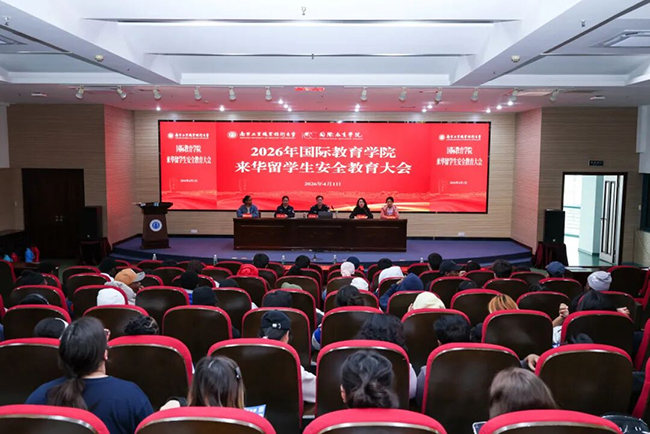
To ensure the safety of international students in their studies and daily life on campus and to strengthen their legal awareness and safety prevention capabilities, the International Education College, in collaboration with the Qixia District Public Security Bureau, held the 2026 International Student Safety Education Assembly on the afternoon of April 1. The event was attended by Lin Haifeng, a fourth-grade senior police officer from the Qixia District Public Security Bureau, police officer Wang Tian, Zhang Li, Deputy Secretary of the Party Branch and Vice Dean of the International Education College and the LSBU-NJUIT Joint Institute, as well as faculty members from the International Education College and all international students.
At the beginning of the assembly, Zhang Li, on behalf of the college, extended a warm welcome and sincere thanks to the police officers from the public security department. She noted that safety is the foundation for international students to successfully complete their academic programs, and that the university has always attached great importance to safety management and service support for international students. The purpose of this assembly, she explained, is to help students gain a comprehensive understanding of Chinese laws and regulations and enhance their self-protection and risk prevention capabilities through authoritative briefings and case-based warnings. She urged all international students to seize this opportunity to diligently study Chinese laws and university regulations, internalize safety awareness and put it into practice, and strive to know, understand, abide by, and use the law.
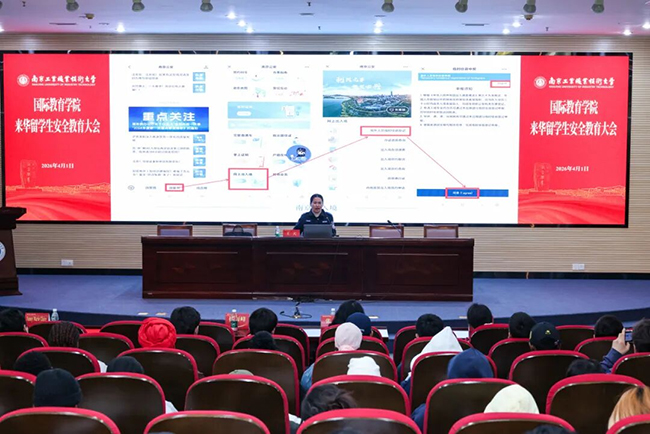
Subsequently, Wang Tian delivered a special lecture on legal education for international students, covering core topics including exit and entry administration, accommodation registration, visas and residence permits, legal employment, public security safety, and telecommunication fraud prevention. Drawing on the Exit and Entry Administration Law of the People's Republic of China, he clarified that foreign nationals must complete temporary accommodation registration within 24 hours of check-in, that students holding X1, Z, and other categories of visas must apply for residence permits within 30 days of entry, and that visa extensions must be applied for before expiration. Overstaying or illegal employment may result in fines, detention, or even deportation.
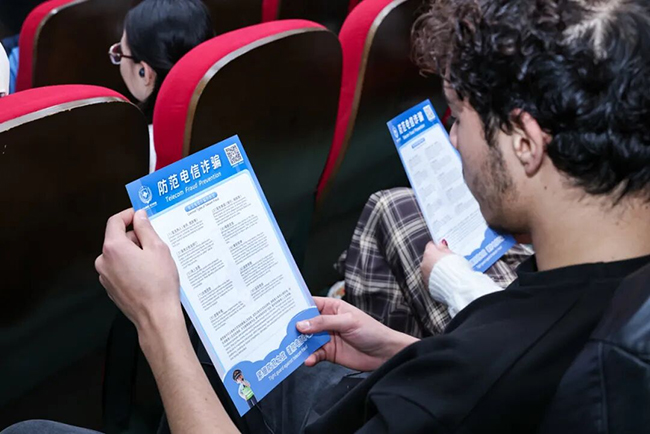
During the lecture, the police officer cited recent real cases from Nanjing and the Qixia District to illustrate legal principles and disciplinary standards. He reported on typical cases involving international students, including overstaying, illegal employment, throwing objects from heights, disturbing residents in groups, theft of non-motorized vehicles, alcohol-related disturbances, and telecommunication network fraud. He provided detailed analysis of fraud schemes such as fake order brushing, online lending, investment scams, online shopping fraud, and impersonation of relatives or public officials. Students were reminded to adhere to the "Three No's Principle"—do not easily trust strangers, do not disclose personal information, and do not transfer money casually—and to proactively install the National Anti-Fraud Center app and remember the 96110 anti-fraud hotline to safeguard their property. Additionally, the officer provided practical information on passport reissuance procedures, no-criminal-record certificate applications, and emergency hotlines. He emphasized that the use of unauthorized electrical appliances and private cooking in dormitories is strictly prohibited, called attention to electrical and fire safety, and urged students to respect Chinese public order, good customs, and religious policies, and to consciously uphold campus and social order.
This safety education assembly featured substantive and highly targeted content, effectively enhancing the legal awareness and safety literacy of international students and laying a solid foundation for building a safe, harmonious, and stable campus environment. Participating students expressed their commitment to strictly abide by Chinese laws and university regulations, standardize their conduct, strengthen prevention awareness, and pursue their studies and lives with peace of mind and enjoyment. They looked forward to spending a safe, fulfilling, and meaningful period of study at Nanjing University of Industry Technology. The International Education College will continue to strengthen cooperation with public security departments, refine the international student safety management system, and provide more robust support for international students' study and life in China.
为切实保障来华留学生在校学习、生活安全,强化留学生法治意识与安全防范能力,4月1日下午,国际教育学院联合栖霞公安分局隆重召开2026 年来华留学生安全教育大会。栖霞公安分局四级高级警长林海峰、警官王天,国际教育学院、伦敦南岸学院直属党支部副书记、副院长张莉及国际教育学院教师、全体来华留学生共同参会。
大会伊始,张莉代表学院对公安部门警官的到来表示热烈欢迎与诚挚感谢,并指出,安全是留学生顺利完成学业的基础,学校始终高度重视留学生安全管理与服务保障工作,本次大会旨在通过权威宣讲、案例警示等方式,帮助留学生全面了解中国法律法规,提升自我保护与风险防范能力。希望全体留学生以此次教育大会为契机,认真学习中国法律与校规校纪,将安全意识内化于心、外化于行,做到知法、懂法、守法、用法。
随后,王天围绕出入境管理、住宿登记、签证与居留许可、合法就业、治安安全、电信诈骗防范等核心内容开展留学生法治教育专题讲座。他结合《中华人民共和国出境入境管理法》,明确境外人员需在入住后24 小时内完成临时住宿登记,持 X1、Z 等签证的留学生须在入境30 日内办理居留许可,签证到期前需及时申请延期,逾期居留、非法就业将面临罚款、拘留甚至遣送出境。
讲座中,警官结合近期南京及栖霞区真实案例,以案释法、以案明纪。通报留学生逾期居留、非法务工、高空抛物、聚众扰民、盗窃非机动车、酒后滋事、电信网络诈骗等典型案件,重点拆解刷单、网贷、投资、网购、冒充亲友及公职人员等诈骗手段,提醒留学生牢记 “三不原则”—— 不轻信陌生人、不泄露个人信息、不随意转账汇款,主动安装国家反诈中心 APP、牢记 96110 反诈专线,守护自身财产安全。此外,警官还就护照遗失补办、无犯罪记录证明办理、紧急求助电话等实用信息进行说明,强调宿舍严禁使用违规电器、禁止私厨,注意用电用火安全,尊重中国公序良俗与宗教政策,自觉维护校园与社会秩序。
此次安全教育大会内容详实、针对性强,有效提升了留学生的法治观念与安全素养,为构建平安、和谐、稳定的校园环境奠定了坚实基础。参会留学生纷纷表示,将严格遵守中国法律与学校规定,规范自身行为,增强防范意识,安心学习、快乐生活,在南京工业职业技术大学度过安全、充实、有意义的留学时光。国际教育学院将持续加强与公安部门的协作,完善留学生安全管理体系,为留学生在华学习生活提供更坚实的保障。